Découvrez une alternative à FilaMeter

Comment SimplyPrint se compare-t-il à FilaMeter ? Quelle est la meilleure plateforme cloud pour l’impression 3D ? Découvrez pourquoi SimplyPrint pourrait bien être ce qui manquait à vous et à votre imprimante sans que vous le sachiez !

Commencer - gratuit à vie Jump to the comparison table

Vous cherchez des alternatives à FilaMeter ?

FilaMeter is a free, local-first filament inventory: a tidy browser app that replaces the spreadsheet you keep your spools in, with your data living right in your browser. It's genuinely pleasant, no login, no ads, and if you just want a private place to write down what filament you own, it does that well.

But FilaMeter is a manual log. You hand-enter every spool, and you tell it what you used after each print; it doesn't connect to your printers and it has no filament database to pull from yet. SimplyPrint's filament manager works the other way around: it's connected to your printers, reads the G-code of every print, and deducts filament on its own, with a real open filament database, NFC, AMS and mobile apps. Here's a fair, side-by-side look, first purely as a filament manager, then as the whole platform.

SimplyPrint filament manager

There's a lot more to the SimplyPrint filament manager

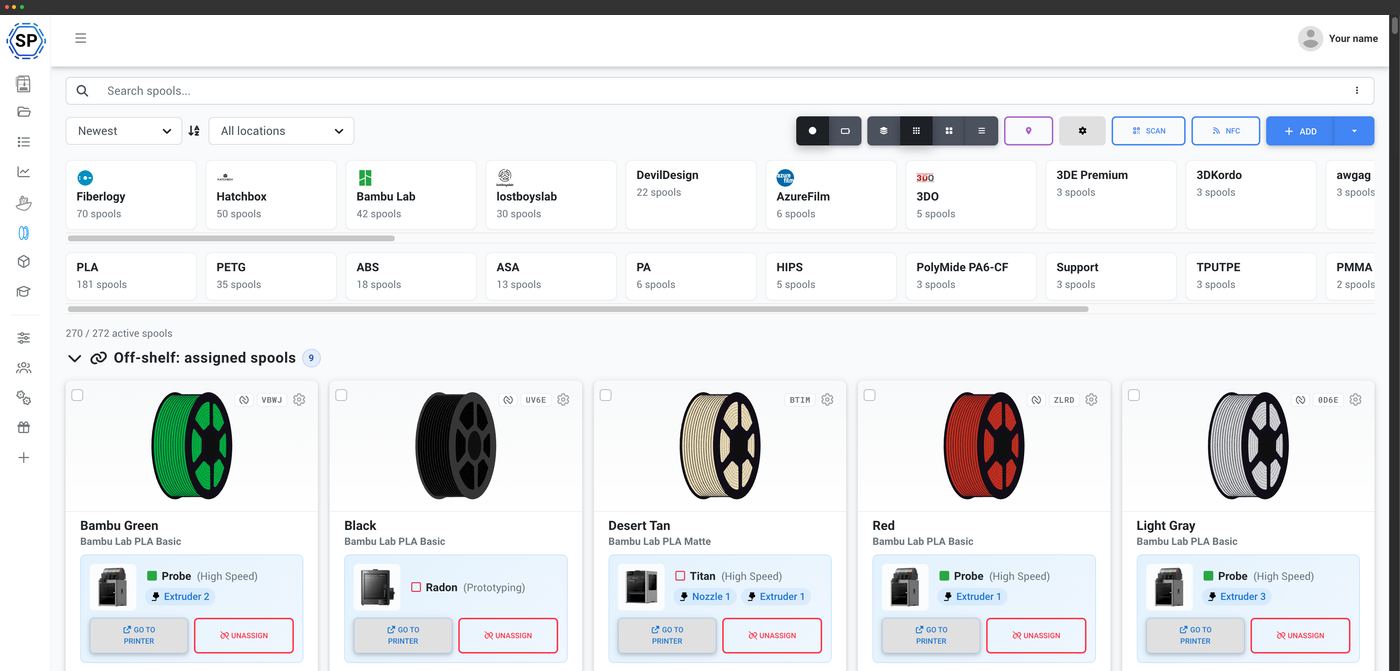
Automatic usage tracking, NFC across every standard, Bambu & Creality AMS auto-import, direct Dymo & Zebra label printing, drying, storage locations, a mobile app and the Open Filament Database. See it all, with screenshots, on one page.

Explore the filament manager
The SimplyPrint filament manager

Compare FilaMeter vs SimplyPrint:

En résumé

FilaMeter is a free, open-source (CC-BY-SA-4.0), local-first spool inventory you run in your browser, a nice fit if you want a private, no-login spreadsheet replacement for a single hobbyist and don't mind logging usage by hand. It's a young 2025 indie app; it doesn't connect to printers and has no filament database yet.

SimplyPrint is a connected filament manager that has been running print operations since 2020: it reads the G-code of every print on your printer and deducts filament automatically, with native NFC, Bambu and Creality AMS auto-import, the open, MIT-licensed Open Filament Database (151 brands and growing, the very database FilaMeter is only planning to adopt), native iOS and Android apps and cloud sync by default. And the filament manager is free on every plan. If you want tracking that just happens, that's SimplyPrint; if a private local log you keep up by hand is the point, FilaMeter is a fine, cheap pick.

Comparing purely as a filament manager, the deep, head-to-head view.

A filament manager that's actually connected to your printer

This is the heart of it. FilaMeter is a manual log: you tell it what you used after each print. SimplyPrint is connected to your printers, so your inventory stays right on its own.

Automatic usage tracking
SimplyPrint
We read the G-code of every print on a connected printer, convert it to grams and deduct it from the assigned spool when the print ends, automatically. No logging, no scale, no spreadsheet.
FilaMeter
FilaMeter has no printer connection of its own. It auto-calculates remaining and used weight from the figures you type in, but you log every print by hand. The only non-manual path is SpoolSense, an unshipped in-spool optical sensor that syncs to FilaMeter, not a printer, and reads no G-code.
NFC, AMS & multi-material
SimplyPrint
Native NFC read and write across Bambu Lab, Creality CFS, Prusa OpenPrintTag, OpenSpool and OpenTag, from your phone, browser or a USB reader, plus Bambu and Creality AMS auto-import that creates the spool, assigns the slot and syncs the AMS-measured weight.
FilaMeter
No NFC, no AMS, no multi-material. FilaMeter has no printer connection to read a slot from, and ships no NFC support; its SpoolSense sensor is optical eInk, not NFC. Spools are identified by an on-screen or bought QR code only.
Labels & hardware
SimplyPrint
Direct label printing to Dymo and Zebra thermal printers, plus native NFC tags. Nothing extra to buy or build.
FilaMeter
No direct thermal printing. Labels are pre-printed QR stickers you buy, or a single on-screen QR per spool you copy or download as an SVG. The one piece of hardware, the SpoolSense optical sensor, is still a preorder.
The core difference is simple: SimplyPrint is connected to the printer, so tracking happens by itself; FilaMeter is a log you keep up by hand.

A real, open filament database, not a planned one

When you add a spool, where does the brand and material data come from? This is the clearest gap, and FilaMeter is refreshingly open about it.

The database
SimplyPrint
Every spool starts from the Open Filament Database, MIT-licensed and stewarded by SimplyPrint, with 151 brands and growing, editable by anyone in a no-code web editor, and wired into your slicing profiles and the automatic deduction.
FilaMeter
FilaMeter has no filament database today, you hand-enter every spool's brand, material and details. The team is openly planning to adopt a filament database (their public issue #120 proposes the Open Filament Database, the very one SimplyPrint stewards), but it isn't shipped.
Where the data goes
SimplyPrint
The same open data backs your presets and the automatic deduction, so adding a spool and tracking it are one connected flow.
FilaMeter
Until that database lands, every spool is typed in from scratch, and consumption is still logged by hand.
It's to FilaMeter's credit that they're planning to adopt the Open Filament Database, SimplyPrint ships it today, with 151 brands wired straight into adding a spool and tracking it.

Where FilaMeter is the better pick

FilaMeter is a well-made little tool, and for some setups it's the right call. Credit where it's due:

Free, private and local-first
SimplyPrint
Free on every plan and ad-free too, but it's our hosted cloud, and you sign in to use it.
FilaMeter
Genuinely free, ad-free and with no login at all. Your data lives in your browser (PouchDB) and works offline on one device, a real plus if local-first privacy is the point. Cross-device sync is a cheap one-time $39.99 lifetime key, not a subscription.
Open-source & self-hostable, simple by design
SimplyPrint
We open-source our data and peripheral tooling (the Open Filament Database, our slicer-profile database, the OctoPrint plugin), but the core platform is hosted, not self-hosted.
FilaMeter
The whole app is open source (CC-BY-SA-4.0) and self-hostable from the public repo as a static export, and it's a fast, zero-onboarding spreadsheet replacement, no clutter for someone who just wants a private spool list.
If you want a free, private, local-first spool log you own outright, and you're happy logging usage by hand, FilaMeter is a fine choice, and a cheap one. If you'd rather the tracking just happen from a connected printer, with a real filament database, NFC, AMS and mobile apps, that's SimplyPrint.
En résumé

FilaMeter does one job, a local filament inventory, and keeps it private and simple. SimplyPrint includes that same filament manager and surrounds it with the rest of a print operation: a print queue, a full cloud slicer, AI failure and bed detection, a maintenance system, teams and permissions, mobile apps and more, in one hosted platform that's free to start. In the table below, FilaMeter's column is filament; ours is the whole platform.

The same filament comparison, plus everything else SimplyPrint does that a local spool log doesn't.

A filament manager that's actually connected to your printer

This is the heart of it. FilaMeter is a manual log: you tell it what you used after each print. SimplyPrint is connected to your printers, so your inventory stays right on its own.

Automatic usage tracking
SimplyPrint
We read the G-code of every print on a connected printer, convert it to grams and deduct it from the assigned spool when the print ends, automatically. No logging, no scale, no spreadsheet.
FilaMeter
FilaMeter has no printer connection of its own. It auto-calculates remaining and used weight from the figures you type in, but you log every print by hand. The only non-manual path is SpoolSense, an unshipped in-spool optical sensor that syncs to FilaMeter, not a printer, and reads no G-code.
NFC, AMS & multi-material
SimplyPrint
Native NFC read and write across Bambu Lab, Creality CFS, Prusa OpenPrintTag, OpenSpool and OpenTag, from your phone, browser or a USB reader, plus Bambu and Creality AMS auto-import that creates the spool, assigns the slot and syncs the AMS-measured weight.
FilaMeter
No NFC, no AMS, no multi-material. FilaMeter has no printer connection to read a slot from, and ships no NFC support; its SpoolSense sensor is optical eInk, not NFC. Spools are identified by an on-screen or bought QR code only.
Labels & hardware
SimplyPrint
Direct label printing to Dymo and Zebra thermal printers, plus native NFC tags. Nothing extra to buy or build.
FilaMeter
No direct thermal printing. Labels are pre-printed QR stickers you buy, or a single on-screen QR per spool you copy or download as an SVG. The one piece of hardware, the SpoolSense optical sensor, is still a preorder.
The core difference is simple: SimplyPrint is connected to the printer, so tracking happens by itself; FilaMeter is a log you keep up by hand.

A real, open filament database, not a planned one

When you add a spool, where does the brand and material data come from? This is the clearest gap, and FilaMeter is refreshingly open about it.

The database
SimplyPrint
Every spool starts from the Open Filament Database, MIT-licensed and stewarded by SimplyPrint, with 151 brands and growing, editable by anyone in a no-code web editor, and wired into your slicing profiles and the automatic deduction.
FilaMeter
FilaMeter has no filament database today, you hand-enter every spool's brand, material and details. The team is openly planning to adopt a filament database (their public issue #120 proposes the Open Filament Database, the very one SimplyPrint stewards), but it isn't shipped.
Where the data goes
SimplyPrint
The same open data backs your presets and the automatic deduction, so adding a spool and tracking it are one connected flow.
FilaMeter
Until that database lands, every spool is typed in from scratch, and consumption is still logged by hand.
It's to FilaMeter's credit that they're planning to adopt the Open Filament Database, SimplyPrint ships it today, with 151 brands wired straight into adding a spool and tracking it.

Where FilaMeter is the better pick

FilaMeter is a well-made little tool, and for some setups it's the right call. Credit where it's due:

Free, private and local-first
SimplyPrint
Free on every plan and ad-free too, but it's our hosted cloud, and you sign in to use it.
FilaMeter
Genuinely free, ad-free and with no login at all. Your data lives in your browser (PouchDB) and works offline on one device, a real plus if local-first privacy is the point. Cross-device sync is a cheap one-time $39.99 lifetime key, not a subscription.
Open-source & self-hostable, simple by design
SimplyPrint
We open-source our data and peripheral tooling (the Open Filament Database, our slicer-profile database, the OctoPrint plugin), but the core platform is hosted, not self-hosted.
FilaMeter
The whole app is open source (CC-BY-SA-4.0) and self-hostable from the public repo as a static export, and it's a fast, zero-onboarding spreadsheet replacement, no clutter for someone who just wants a private spool list.
If you want a free, private, local-first spool log you own outright, and you're happy logging usage by hand, FilaMeter is a fine choice, and a cheap one. If you'd rather the tracking just happen from a connected printer, with a real filament database, NFC, AMS and mobile apps, that's SimplyPrint.
Join 95.000+ print farms & hobbyists
who use SimplyPrint
Commencer

Gratuit à vie. Sans carte bancaire.

Our users love us. Rated Excellent on Trustpilot.

Note Trustpilot de 4.7

Comparatif entre FilaMeter et SimplyPrint

Nothing is black-and-white, and there are always pros and cons to consider when choosing a 3D printing cloud solution!
And we're not here to simply tell you, that SimplyPrint is the best - we want you to make an informed decision, and of course there are pros of using FilaMeter as well!

Avantages de FilaMeter

FilaMeter has real strengths, and they're worth being honest about:

  • Genuinely free, ad-free and no-login: the full single-device inventory isn't paywalled, there are no ads, and you don't even make an account.
  • Local-first and private: your data lives in your browser (PouchDB), works offline on one device and never has to leave your machine, a real plus if privacy or offline use matters.
  • Open source and self-hostable: the app is open (CC-BY-SA-4.0) and you can self-host it from the public repo as a static export.
  • A cheap one-time sync key, not a subscription: cross-device real-time sync is a single $39.99 lifetime purchase, with no recurring fees.
  • Simple, fast and complete enough: a zero-onboarding spreadsheet replacement with a manual usage-history log, per-spool price, and import/export for backup and migration, by a small team shipping conventional releases.

Inconvénients de FilaMeter

Where FilaMeter falls short if you want tracking that just happens:

  • It isn't connected to your printers: FilaMeter never measures usage itself. It auto-calculates remaining weight from the figures you type, but you log every print by hand; its SpoolSense optical sensor is unshipped and syncs to FilaMeter, not to a printer, and reads no G-code.
  • No filament database yet: there's no brand or material catalogue to pull from, so every spool is hand-entered. Adopting one (the Open Filament Database) is an open plan, issue #120, not a shipped feature.
  • No NFC, AMS or direct label printing: native NFC read/write, Bambu and Creality AMS auto-import and direct Dymo/Zebra thermal labels aren't built in. Labels are bought QR stickers or a single on-screen QR per spool.
  • No app to install and a flat data model: there's no native iOS or Android app on the App Store or Google Play (it's a responsive website that ships a web manifest but no service worker), location is a single free-text field with no nesting, and notes are one free-text comments field with no custom fields.

FilaMeter vs SimplyPrint

Comparaison côte à côte des détails et fonctionnalités de FilaMeter et de SimplyPrint

FilaMeter logo SimplyPrint logo
Filament management
Free to use
Open-source / self-hostable ? Open source, but CC-BY-SA-4.0 (content license)
Filament database ? Open Filament Database
Connects directly to your printer ?
Automatic usage tracking (no manual subtracting) ? Manual log; auto-calculates from figures you enter
AMS auto-import (Bambu / Creality / Anycubic) ? Bambu, Creality, Anycubic + more
Read filament NFC tags
Write filament NFC tags
Label printing (direct to Dymo / Zebra) Dymo & Zebra
Barcode / QR scanning On-screen QR only (opens a URL)
Drying tracking
Storage locations Single free-text field, no nesting
Cost & spend tracking Price field; no purchase date / vendor
Custom fields
Mobile app (iOS & Android)
Multi-user / team access
Import your existing spools ? Import/Export (CSV/JSON); no direct importer
Developer API for filament data ?
Comparer En savoir plus En savoir plus
FilaMeter logo SimplyPrint logo
Filament management
Free to use
Open-source / self-hostable ? Open source, but CC-BY-SA-4.0 (content license)
Filament database ? Open Filament Database
Connects directly to your printer ?
Automatic usage tracking (no manual subtracting) ? Manual log; auto-calculates from figures you enter
AMS auto-import (Bambu / Creality / Anycubic) ? Bambu, Creality, Anycubic + more
Read filament NFC tags
Write filament NFC tags
Label printing (direct to Dymo / Zebra) Dymo & Zebra
Barcode / QR scanning On-screen QR only (opens a URL)
Drying tracking
Storage locations Single free-text field, no nesting
Cost & spend tracking Price field; no purchase date / vendor
Custom fields
Mobile app (iOS & Android)
Multi-user / team access
Import your existing spools ? Import/Export (CSV/JSON); no direct importer
Developer API for filament data ?
Général
Propose un forfait gratuit
Free printers 2
Coût max. Free Free, or from $4/printer/mo
Stockage cloud gratuit 1GB
Coût basé sur l’utilisation
Impression illimitée
Prend en charge toutes les imprimantes
Fonctionnalités
Accès à distance
Connaît votre imprimante
Fichiers cloud
File d’impression
Diffusion en direct
Analyse Gcode
Détection des échecs par IA
AI Bed Check (is the bed clear?)
AutoPrint / impression continue
Maintenance & servicing system
Custom fields
Staggered Start (for power draw)
Historique des tâches d’impression
Imprimer à distance
Slicer intégré
Adapté au multi-imprimantes
Impression groupée
Multi-diffusion
Statistiques
API
Rotation intelligente du slicer
Changement de filament intelligent
Assistant de mise à niveau du plateau
Organisation
Plusieurs utilisateurs
Groupes d’utilisateurs / rangs
Permissions des utilisateurs
Forfait School
Fichiers & dossiers partagés
Profils de slicer partagés
Hub
Domaines personnalisés
SSO (authentification unique)
Notifications
Notifications par e-mail
Notifications push (mobile / application)
Notifications par SMS / message texte
Applications
Application Android
application iOS
"PWA" (application web installable)
Security & privacy
Authentification à deux facteurs du compte
Analyses & collecte de données respectueuses de la vie privée ?
Assistance
Assistance par chat en direct
Assistance téléphonique
Assistance par e-mail
Prise en charge du firmware & de la passerelle
Installation d’OctoPrint
Prise en charge native de Moonraker
Installation de Mainsail
Installation de Fluidd
Prise en charge de Klipper
Intégration Duet3D
Prise en charge directe de Prusa (MK4, XL et plus récents / nouvelles cartes mères)
Intégration directe des imprimantes Bambu Lab
Prise en charge des intégrations personnalisées
Entreprises & partenaires
OEM
Programme partenaire (revendeur / distributeur)
Programme d’affiliation
On-prem / self-hosting ? Contact us
Comparer En savoir plus En savoir plus

Contactez-nous si vous pensez que nous avons commis une erreur dans notre comparatif !

FilaMeter vs SimplyPrint : questions fréquentes

Is SimplyPrint or FilaMeter better for filament tracking?

It depends on what you want. FilaMeter is the better fit if you specifically want a free, private, local-first spreadsheet replacement for a single hobbyist and you're happy logging usage by hand. SimplyPrint is the better fit if you want filament tracking that happens automatically: it connects to your printers, reads the G-code of each print and deducts filament on its own, with the Open Filament Database, native NFC, Bambu and Creality AMS auto-import, direct Dymo/Zebra labels and native mobile apps, free on every plan.

Does FilaMeter track filament usage automatically?

Not from your printer. FilaMeter has no printer connection; it auto-calculates remaining and used weight from the figures you type in, but you log every print by hand. Its only non-manual path, SpoolSense, is an unshipped in-spool optical sensor that syncs to FilaMeter, not to a printer, and reads no G-code. SimplyPrint reads the G-code of every print on a connected printer and deducts usage automatically, with nothing to log.

Is FilaMeter free, and what does the $39.99 buy?

The core app is completely free, ad-free and needs no login, with the full single-device inventory included. The only paid option is a one-time $39.99 "lifetime sync key" that unlocks real-time cross-device sync, it's a single purchase, not a subscription, which is a nice touch. SimplyPrint's filament manager is also free, included on every plan down to Free, with automatic tracking, the Open Filament Database and cloud sync by default.

Does FilaMeter have a filament database?

Not yet. FilaMeter has no brand or material catalogue today, so you hand-enter every spool. To their credit, the team is openly planning to adopt one, their public issue #120 proposes the Open Filament Database, which is the very community database SimplyPrint stewards and ships. In SimplyPrint that database is already there: 151 brands and growing, in a no-code web editor, wired straight into adding a spool and tracking it.

Does FilaMeter work with the Bambu Lab AMS or NFC tags?

No. FilaMeter has no AMS integration and no NFC reading or writing, it has no printer connection to read an AMS slot from, and its SpoolSense sensor is optical, not NFC. Spools are identified by an on-screen or bought QR code. SimplyPrint reads Bambu and Creality AMS tags to auto-create and auto-assign spools and sync their weight, and reads and writes NFC across Bambu, Creality CFS, Prusa OpenPrintTag, OpenSpool and OpenTag from your phone, browser or a USB reader.

Does FilaMeter have a mobile app?

No native app. FilaMeter is a responsive website; it ships a web manifest but no service worker, and there's no app to install on the App Store or Google Play. SimplyPrint has native iOS and Android apps, so you can scan, assign and track filament from your phone, and your inventory syncs across devices by default.

Can I move my FilaMeter inventory into SimplyPrint?

Largely, yes. FilaMeter has its own Import/Export (CSV/JSON), so you can get your spools out, and SimplyPrint can ingest a CSV/JSON inventory, with brands matched against the Open Filament Database as they import. There's no dedicated one-click FilaMeter importer, so it's an export-then-import rather than a single button, but your data isn't locked in.

Conclusion
Why SimplyPrint is the Top FilaMeter Alternative

Nous avons créé SimplyPrint parce que rien d’autre sur le marché ne correspondait vraiment à nos besoins. Nous voulions une plateforme facile à utiliser, mais disposant de toutes les fonctionnalités dont nous avions besoin. Nous voulions une plateforme riche en fonctionnalités, intuitive et simple d’utilisation, offrant une excellente expérience utilisateur et une véritable innovation dans le domaine des logiciels de gestion de l’impression 3D.

En résumé, nous pensons, humbles et impartiaux comme nous le sommes 😉, que la plateforme SimplyPrint est une excellente alternative à FilaMeter !

Commencer - gratuit à vie

On this page